
 1. Hi Russ, thanks for being with us today. Give our readers a run down as to what you do and what your website is about.
Great to be here.
I’m a personal trainer and online fitness entrepreneur. My blog provides training tips, while my website provides daily workouts from myself and a host of other trainers.
- When did you first get into weight lifting and exercising?
When I was a kid I had a condition called Perthes disease, which caused my left hip to crumble. As a result I had a start strength training at a young age.
Back then of course, it was simply to start walking again and I had no idea it would go on to become my career. Once I could walk again I put it all on the backburner, and didn’t re-start until I was around 17.
By that time, yeah, it was to get girls. I’ll admit it.
- What was it that inspired your to get started?
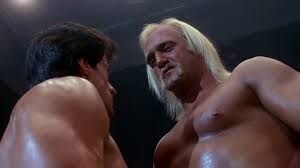
Rocky IV! At the time I thought they looked great and I wanted to look like that when I grew up, but when I started reading up on training and realized the amount of work which went into achieving that physique, I was blown away.
It is true that your body is a tool with which you can create whatever look you wish, as long as you have the drive to make it happen.
- Aww but Rocky III was the best! – Thunderlips all the way! As an aspiring bodybuilder, to me, working out and nutrition is more than just a hobby. Its a lifestyle. When fitness become more than just a hobby to you?
That separation from hobby to lifestyle never happens for a lot of folks. For many, it’s just “the thing to do”. You hit chest on Monday, skip legs (HAHA) and go to the gym on a Friday night to train arms before you hit the town.. All the guys in the office are doing it and it’s more of a social thing than anything else.
But there comes a point where every serious lifter decides to prioritise it over other aspects.
For me, that took a long time.
I was always a shy kid and therefore scared to ask for advice. So when I was training in my late teens it was in my bedroom and I was really just messing around without knowing what the heck I was doing. In my early twenties I discovered a book called Maximum Growth II by Stephen Adele and it changed everything.
That was the first time I had something which laid out a set structure and it worked – much better than the endless sets of biceps curls I was doing!
The first time people began commenting on my physique at my job, I was sold. I guess it was the shy kid in me, suddenly having this sense of pride, I knew this was something I’d never stop doing. So I progressed my learning through classic books like Joe Weider’s Ultimate Bodybuilding and Arnold Schwarzenegger’s Encyclopedia. That opened my eyes to the various styles of training.
- The world of fitness can be confusing, with so many methods, training plans and ways to achieve a good physique. How do you personally workout?
To me, this is one of the biggest problem in the fitness world; too many different styles and too many closed minds.
Most people are looking for one “best” way and truthfully there isn’t one. And too many ‘experts’ claiming that their way is right and everyone else is wrong. I experienced that when I first started lifting weights. As a result people jump from program-to-program every month when they see them in magazines, never sticking with anything long enough to see results and always worrying that the grass is greener on the other side.
As soon as I started seeing results and friends could tell I lifted weights I had tons of people at work telling me to ditch what I was doing and do what they were doing instead. It’s no wonder people get confused.
For me a high intensity, high volume approach has always worked best. I like to go to war.
I’ll move quickly between sets with as little as 20-30 seconds rest, but keeping the weights as heavy as possible. Lot sof supersets and dropsets. It destroys me, but it works for me.
- Give us a run down of your training split.
I train six days per week, usually as follows:
- Monday – Legs.
- Tuesday – Arms and abs.
- Wednesday – Chest, Back and a 20 minute sprint session
- Thursday – Shoulders and a 20 minute sprint session.
- Friday – Legs and arms.
- Saturday – Chest, Back and abs.
This is something I’ve adapted over the years to adhere to my own weak points.
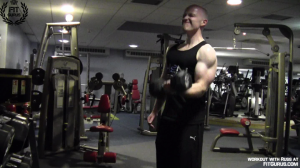 I find that training shoulders once per week is enough for me, whereas my chest and lats don’t respond and need more frequency. My favourite body part to train is legs. Something about that burning pain that I love. I sometimes like to slot a mini arms session after my second leg workout of the week to take advantage of the growth hormone spike.
- And would you apply this exact same method to your clients? Or do you view every person as needing a different solution?
I think there are certain things which can help everyone, such as a focus on compound movements and protocols such as high intensity interval training.
But beyond the basics, you need to experiment a little.
One of the things you have to do as a trainer is monitor everything. There’s no guarantee what worked for you will do the same for someone else. I think the moment you start believing you’ve found “the secret system” you become one of those trainers with a closed mind who rejects new principles.
We still have trainers in our industry who claim thay women will get bulky if they lift weights. I’d hate to be programmed that way.
- What are some of the more unconventional things that are in your routine. Exercises people might look at you and think “why the hell is Russ doing that?”
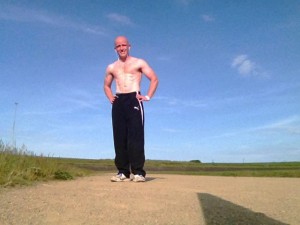 The way I train contradicts what many guys like to do.
You’re told to either go heavy for low reps or go light for high reps. I like to go heavy for high reps. I’ll also restrict rest periods massively, turning my weight training into a form of HIIT.
I enjoy feeling as if my muscles are going to burst.
Guys regularly invite themselves into my workout to tell me that I should be doing 8 reps then taking 90 seconds rest. Anything more than 12 reps is for girls, for “toning up”, right?
Well how “toned” you look depends upon how much body fat you have, not whether you’re doing endless reps with pink fluffy dumbbells. Studies out there confirm that the body builds just as much lean muscle with higher reps as it does with lower reps, the only key difference being higher reps will give more muscular endurance while lower reps will give more strength. So mix up your approach. The key is no matter how many reps you’re aiming for, use a weight which causes muscular failure.
In terms of exercises, I have a few favourites:
- Single-Arm Cable Flyes – by working one side at a time we can bring the pulley all the way across our chest to the opposite shoulder. This engages the muscle fibers of the inner pecs much more than conventional flyes.
- Single-Arm Low-To-High Cable Flye – same as above, except I work from a low position and bring the pulley up diagonally. Again, reaching for the opposite shoulder. This is a tremendous way to target the upper region of the pecs and develop that ‘split’.
- Prone Incline EZ-Bar Curl – this is my favourite biceps exercise and causes a pump like no other.
- Triceps Kickback – an exercise often viewed as “for the girls”, it was recently shown to activate almost 50% more muscle fibers than pushdowns. I like to do this on a cable station, gripping the cable itself, to maximize tension.
- Step Ups – another ruined by images of spandex-clad 1980’s fitness instructors, this is a great exercise and one which allows you to go incredibly heavy. If you want to get an ass, these are your best friend.
- Muscle Sandwich – this is a technique I like to pull out from time to time in order to shock a muscle. I put a heavy isolation exercise in the middle of two bodyweight compounds. For example, 10 chin ups into 15 EZ-bar curls into 10 chin ups. Here’s one of my favourites – 10 bodyweight squats into 20 heavy leg extensions into 40 bodyweight squats. That’s one set, I’d do five. Your body doesn’t know what’s hit it. The first time I did that I had to take the lift out of my gym.
And I feel like I should whisper this, but the abductor and adductor machines have become little favourites of mine due to the benefits they pass over to bigger moves like the deadlift. I go for 5 second holds during the peak contraction.
- Are there any exercises that you would never recommend to someone?
Not really. I think they all have their place.
Working in the gym I often hear people dismiss certain training equipment such as kettlebells or the smith machine. But just because you don’t use something doesn’t make it bad. I believe everything has it’s place and there are ways you can adapt any equipment
- What is your approach to training for muscle mass, compared to training for fat loss?
The majority of my own training is geared around fat loss and fitness, hence my high volume approach.
But when it comes to packing on size I think the old classics still rule all.
Arnold’s 5×5 routine, German Volume Training, they still work.
When pure size is the goal, I believe we benefit from less volume and our diet needs to change to reflect our goal. I see too many people trying to base their results off what they’re doing in the gym and not changing the structure of their diet. They work hand in hand and, as I’m sure we’ll get into later on, your diet is the key to seeing the results you’ve worked for on the gym floor.
- Moving onto diet and supplementation. Tell us about the supplements you use.
There’s a mountain of supplements out there nowadays and if you’re not careful you can get sucked in by all the hype. Before you know it, you’re spending £400 a month and don’t even know what half the stuff is supposed to do!
I’ve been there.
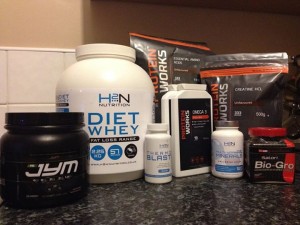
I stick to the basics – whey protein, creatine hcl, caffeine and cla.
I also use a multivitamin and omega-3’s.
Occasionally I’ll experiment with something new to see how I respond to it, but I usually just stick to my little “go to list” above. For instance, I recently trialed iSatori Bio Gro. Given my high protein diet it seemed like a good supplement for me and it worked surprisingly well. Something I’ll probably go back to in the future.
- We have a ton of choice when buying supplements online these days. Bulk suppliers such as My Protein, Protein Works, Go Nutrition and the likes are gaining ground with more established brands such as BSN, Maximuscle, Opmtimum Nutrition. Do you think people need to go with the ‘big brands’ or do you think the bulk suppliers deliver equal quality?
On the whole, this is a good thing.
I don’t think you need to stick to the big established brands because this “new breed” of supplement manufacturers are providing products which do the job, often at a far lower price. It’s a good thing because it’s forcing the bigger names to re-think their strategy and raise their game.
Of course, this is not all good news.
Alongside the good manufacturers you have listed above, who are very clear about their ingredients and dosages, there’s a slew of bottom-of-the-range supplements being pumped out by companies who hide behind proprietary blends.
- What is your go to brand of supplements?
The Protein Works, H2n and iSatori.
- What is your favourite supplement from their range?
Diet Whey from H2N Nutrition. Without a doubt the best tasting protein I’ve ever used, and a firm favourite among my male and female clients.
Creatine HCL from The Protein Works.
Isatori has been a brand I’ve followed long-term, mainly for their preworkout range but Bio Gro is a new favourite of mine.
- I’ve got a tub of Bio Gro sitting in the house, but haven’t gotten round to it yet.Do you use different protein supplements such as whey protein at certain times in the day, and then casein before bed?
I tend to use a whey protein throughout the day mixed with water, and casein at night.
- How do you incorporate supplements into your diet, so that you have a good mix of whole foods and supplements?
The majority of my diet is whole food. I like to eat!
To be honest, I’m not a big fan of living on pills and powders.
To me, the biggest benefit to using supplements has always been convenience. I like to get around 4-5 whole food meals every day and then supplement around this with 2-3 whey protein shakes.
- How do you establish macros for weight gain?
A lot of your “ideal” macronutrient split is going to depend upon your diet history and carb tolerance.
Which is why it’s not uncommon to see someone try their friend’s diet setup and not get the same results. It just takes time to figure out what your body can handle. After all, you want to gain size, not fat, right?
I really appreciate that you’re giving me an opportunity to answer these questions, so I want to go as in depth as possible here and explain my approach to nutrition. So here goes.
When I’m trying to gain size, this macronutrient split sets the baseline and gets the job done:
- 1.5g protein per lb goal body weight
- 1.5g carbohydrates per lb goal body weight
- 0.5g fat per lb goal body weight.
Carbohydrates remain the key factor here. I’ll leave my protein and fat intake at relatively high levels and monitor my response to this level of carbs over a three-to-four week period. If I feel I am not gaining enough size I’ll increase carbs to 2g per lb. On the other hand, if I feel I’m unable to handle this amount of carbs without gaining body fat I’ll lower it slightly.
The trick is to always be looking to increase your carb intake over time.
As soon as I feel I can handle a particular carb intake without gaining body fat, I’ll increase it slightly. Not only does this allow me to gain size, it also makes it far easier when I want to go on a cutting phase later on.
- How would this caloric intake differ when trying to lose fat?
Following on from above, when I want to go through a cutting phase I simply modify my carb intake.
Here’s a solid six week fat loss setup for those who just want to jump in and get results:
Weeks 1-2:
- 1.5g protein per lb goal body weight.
- 1.5g carbs per lb goal body weight.
- 0.5g fat per lb goal body weight.
Weeks 3-4:
- 1.5g protein per lb goal body weight.
- 1g carbs per lb goal body weight.
- 0.5g fat per lb goal body weight.
Weeks 5-6:
- 1.5g protein per lb goal body weight.
- 0.6g carbs per lb goal body weight.
- 0.5g fat per lb goal body weight.
Notice how it’s broken up into stages. This is something I see a lot of people overlooking.
I always tell people to treat their diet like their training plan. In order to progress, it needs to change. The body’s best weapon is it’s ability to adapt, so if you’re setting out a macronutrient intake and it works for a few weeks then progress suddenly halts, don’t be surprised.
I would also advise (particularly during stage 2 & 3) taking one day per week off to consume plenty of carbs. This will prevent your body from slowing the metabolism and adapting to your diet. I’d also advise reversing back out of this after the sixth week, rather than suddenly bumping your carb intake up massively. That’ll allow you to get back to consuming plenty of food each day without regaining the weight you dropped.
However, for those who want to get a bit more in detail and customize their plan to suit their body, this is where the benefit of consuming plenty of carbs per day (as I mentioned above) really comes in handy.
By working with clients to build their carb tolerance, it allows them to diet without necessarily feeling like they are dieting at all.
After all, who’s going to find it easier to cut fat – the girl who took her time to build her metabolism and maitain her weight eating 4000 calories per day, or a girl who is only eating 800 calories per day and avoiding carbs like the plague?
For instance, at the moment my carb tolerance is around 3g per lb goal body weight, so if I want to cut fat all I need to do here is lower my carb intake to 2.5g per lb goal body weight. Despite the fact I’m still getting well over 200 grams of carbs per day here, I’m actually dropping body fat because technically I’m cutting carbs. Whenever I hit a plateau, I’lll lower carbs by another 0.5g, and the example diet above represents the lowest I’ll ever go. Often I don’t need to go this low.
Once I’ve reached my target, I’ll slowly reverse back out of the cutting phase by increasing my carb intake by around 0.5g per lb whenever I can. If I’m not gaining body fat with a certain intake, I’ll increase. If I do gain body fat, I’ll go back down and increase by a little less (0.25g instead of 0.5g) and work my way back up.
This basically teaches your body to skip the weight regain issue which many people go through after finishing a diet plan and bumping their calorie intake back up too quickly, and allows you to maintain your physique year-round so you’re not always bulking and cutting.
I recently shot a lot of videos with actor Adam Baroni as he prepared for Dragonball Z and Sophie’s Fortune, and Adam was able to enter physique shows at very short notice due to the fact he’s taken time to build his metabolism and learn what works for his body. He can stay lean all year round. It’s dieting without dieting. You should never look to “starve yourself” to lose weight, simple as that.
And by taking the time to boost your tolerance towards carbs, it allows you to become one of those annoying motherfuckers who can seemingly eat anything and not gain weight.
Just takes time.
In the beginning I didn’t have the patience to really learn about my nutrition. I just wanted results right then and there. However, when you get the lifting bug you really do get it for life. This is something you’re probably gonna do forever, so I’d advise clients to take their time with it and make it easier for themselves in the long run.
- How important is meal timing to you? Do you eat every 2.5-3 hours , or do you not worry about timing, as long as you hit your goals for the day?
This is something I’ve had to study quite a lot, as I often get clients coming to me having heard various different approaches to nutrition.
Some people prefer to have a few big meals while others prefer plenty of smaller meals. You’ll either love the smaller meal approach and feeling light on your feet all the time, or you’ll hate it and constantly feel starving.
To be honest, I don’t mind which approach somebody uses as they both work.
As it’s my job, I need to constantly be looking for new science on various methods in order to provide the type of service my clients are used to. And there’s no conclusive evidence out there which shows consuming smaller, more frequent meals will boost the metabolism, despite the fact it’s often quoted by trainers. However, there is useful evidence out there which shows that consuming one of the macronutrients (protein) at regular intervals can increase fat loss.
So the main guideline I give to clients (and I use myself) is to aim for 4-5 meals per day and supplement around that with shakes.
That way, they’re getting decent meals inside them and still regularly topping up their protein intake to get the fat loss benefits it yields.
- What does a typical day of eating look like to you?
I tend to stick to the basics.
The old classics; oats, eggs, steak, chicken, fish, nuts, greens.
I always like to keep these as the staple of my nutritional setup, which provides a solid foundation each day and then allows me to play with various extras. No two days tend to be the same.
Yesteday I ate a total of 272g protein, 490g carbohydrates and 90g fat.
- What is your take on post workout shakes. There are many schools of thought. Some believe carbs only. Some believe protein only. Some believe a mixture of the 2. Others believe to neglect the shake and just have a meal when you get back from the gym. What do you do for post workout nutrition?
I like to grab a whey protein shake alongside 30g gummy bears.
You’ll still get results with straight protein, but carbs have been shown to increase those results just a little bit further.
One of the biggest mistakes I made when I was starting out was the amount of carbohydrates I would consume following a workout. Following the instruction of guys at my local gym, I’d happily eat an absolute ton of carbs alongside my shake because I figured it would increase results further.
I’d leave the gym feeling bloated to hell.
However, recent studies show that if you’re consuming protein after a workout, as little as 30 grams of carbs produces similar results to 90 grams.
I get that in the form of gummy bears, an old bodybuilding favourite. You could get a shake which has all the necessary ingredients of course, but basically we just want dextrose – what’s the main sugar in gummy bears? You guessed it. The main reason I do this, however, is that it feels like a ‘treat’ without necessarily being one. You have to give yourself those little psychological boosts whenever you can.

- What would be your go to ‘cheat meal’
Pizza.
I’ve always loved it!
- If you’re craving something sweet, would you do some protein baking to make a healthier alternative, or just have the real deal?
For me, I’d rather just have the real thing.
If I have time I’ll always look for the best option but I don’t consider this a big deal. I work hard in the gym and enjoy what I do, I think I respond best to “everything in moderation” dieting.
- Some personal trainers look the part, but don’t quite have a strong enough education to explain their training methods. Likewise some trainers pass a course, get a qualification, but look like they’ve never stepped foot in a weight room. You blend both of these elements together, having the physique and the knowledge. Do you believe it is important for a trainer to look as though they practice what they preach?
Great question!
One thing I picked up very fast in this industry is that your mind is your product and your body is your sales package.
Some people like the “idea” of being a personal trainer, but not the reality.
The like the idea of walking round a Hollywood gym surrounded by girls swooning at their every word. But this isn’t some sort of fantasy life.
If you look great but don’t own any qualifications or experience, you will get found out. Likewise, if you have a wall full of certificates but look like you don’t even enjoy training, you’ll get nowhere fast.
How you look will ultimately determine what type of client you attract, too.
- If someone was reading this, and wanted to become a personal trainer, where would you recommend they start?
This is something I get asked quite a lot, and there are two things I always tell people.
The first thing you need to do is get a qualification of some sort. You’ll see ads on television about this sort of thing, but the best place you can go to is your local college. You can bet your bottom dollar it’ll be cheaper and have a much more hands-on approach.
I remember during my own qualifications back in the day, my tutor was actually a member of the Team GB Judo squad from the 1992 Barcelona Olympics. You just pick up so much more from doing it that way, as opposed to a learn from home course.
And the second thing, this is the big one..
Realize that the qualification you have just earned doesn’t mean shit.
Sure it looks nice. But it’s like passing a driving test. You’re taught the basics, the fundamentals, the “government guidelines” on nutrition and training. And guess what my friends, most of those government guidelines are absolute bullshit.
Because they’re written by people who don’t train, for people who don’t train.
You go to a bodybuilder and tell him he needs to “engage his core” or look at the damn healthy food pyramid and he or she will treat it with the contempt it deserves.
Start learning different approaches to training immediately. Not only that, start applying them so you can develop experience with various systems and protocols.
You see, now that you’ve got your qualification, so have thousands of others. You need to stand out and develop your own style.
Because I’m guessing you don’t want to get into the fitness industry to work in a gym and run inductions all day long, right?
No, you probably want recognition for what you do. People coming up to you saying they follow your programs or they wanted to meet you because your work inspired them to get in shape. In order to do that, you need to stand out.
And it’s an easy thing to do – you just need to love this.
No matter what you do, always be the hardest worker in the room.
You see, when I’m not working with clients, I’m training myself. And when I’m not training myself, I’m researching for new methods and looking up studies which can help me better myself. I find it fun. The Journal of Strength and Conditioning Research is my friend! That makes it sound like I’m always at work, which is not the case, I have two kids, but I am consistent with my work. I do something every day. And over time that consistency has made me a popular trainer.
Just see the bigger picture when you’re starting out.
I saw a lot of personal trainers struggling to get clients and earn money, wondering how to get their foot in the door so-to-speak.
In the early days, I didn’t mind doing things for free. Colleages would scoff and say there’s no way in hell they’d help someone or spend time writing tips and programs without being paid for it. They called me crazy. But that got my name out there. That got me my first few testimonials. And those early articles and plans I wrote formed the foundation of what I have now with my website.
Sometimes just getting your name seen by the right people is better than being paid for a job. Always be looking for the opportunity to grow your reputation and your brand.
If you focus on doing that, you won’t have to look for jobs!
- Give us the 3 biggest workout or nutrition based myths you’ve heard.
- Women will get bulky from lifting weights.
Around 70% of my clients are female and I hear this myth all the time. Those female bodybuilders you see in the magazines didn’t just do three sets with a heavy weight and get that physique, they worked their butt off specifically trying to reach that goal.
It frustrates me that so many people believe you can do that just by lifting a heavy dumbbell.
It that was the case, every guy would be walking around looking like Rambo!
The female body releases far less testosterone than the male body, the reaction to lifting weights is very different. You’ll get leaner and fitter, you’ll develop more shape and strength. But you won’t become a female bodybuilder without spending years trying to do so.
- Celebrity crash diets.
These are the bain of my life.
Every few weeks there is a new “superfood” or a new diet which is based around eating barely any calories in a bid to drop five dress sizes in a month.
Sure you lose weight – because you’re starving yourself.
Then the body adapts to this starvations lifestyle and you hit a wall where you cannot drop body fat despite seemingly eating no food and exercising religiously. Frustration gets the better of you and you binge eat, regaining any weight you lost due to the sudden influx of calories. Then these fads will have you believe it was your fault for being “weak”, so you need to start your next crash diet and go even harder next time… It’s a never ending cycle of nonsense.
Another thing which surrounds this myth is the workout dvd’s that often go hand-in-hand with this type of dieting.
The Z-listers you see in those magazines endorsing these things, I’m sure it must be some kind of second career for them. Every April they’re pictured looking out of shape, every Christmas they have a new workout dvd in the stores. This not only shows it’s total nonsense, it also shows whatever gimmick they were following clearly doesn’t work as they’d piled all the weight back on as soon as they released their dvd!
There is no gimmick, you don’t need to starve, you don’t even need to stop eating cake.
- Hit the gym more than 3x per week and you’re “overtraining”.
As soon as you start training, you’ll have a guy at your office who has read about overtrining in a magazine and suddenly wants to tell you that you’re doing too much exercise.
It’s a real buzzword in the fitness community at the minute.
You’ve gone from not doing enough, and now you’re doing too much?!
The body is capable of handling far more than most people think. I remember reading a brilliant study from Brazil which looked into the effects of overtraining in 400+ weight trainers following an incredibly high workload on a weekly basis. Researchers discovered that, despite all of them complaining they worried about whether they were overtraining, only a tiny fraction actually were.
That’s not to say overtraining doesn’t exist. It does exist. But if you’re getting adequate nutrition and rest, you’d need to be taking on a mammoth workload to see it occur.
- What advice would you give to someone looking to get in shape?
Sort out your nutrition before you begin training.
Diet is the part the majority of people struggle with. So get into the habit of eating better before you begin training. You’ll already begin seeing results.
When you start training, don’t look to overdo it. Just practice your compound lifts master them. You’ll get results from this purely because you’ve never lifted before, so enjoy it.
- How would this advice differ from a casual gym goer, looking to just get in shape, compared to someone who is looking to get on stage and compete in a physique or bodybuilding contest?
By the time you consider entering a show or using your physique as your potential career, you will already know most of the techniques and approaches to dieting which work for your body.
But don’t stop learning and don’t get daunted by the fact that, like any career, it takes time and skill to move forward.
You could be in the best shape at your local gym, but you go from that environment to being on a stage where every other guy next to you is also in phenomenal shape, I’ve seen that psyche a lot of people out. “Big Fish To Little Fish” syndrome.
One more thing on this question which I want to make sure I mention – don’t ever just look to get on stage and compete.
Anyone can compete. Look to get on stage and win. Don’t aim for anything less unless you’d be happy to achieve anything less.
- What projects have you got lined up for the rest of the year?
I have just launched FitGurus.com which is my “baby”.
It’s something which I have worked on with a couple of trusted colleagues (Paul Slater and Dave Stidolph) for quite some time and it went live in August 2014.
We wanted to create the Netflix of the fitness industry, and that’s probably the quickest way to describe what people get from Fit Gurus. Alongside myself, we have several other proven personal trainers and customers are able to simply log in, choose a daily workout or a full 4-6 week schedule and go do it in the gym. Simple as that. Every day new content, customers pay £4.99 a month and unlock the whole site.
Initial response has been great and I think that’s due to it’s simplicity. So the majority of my work this year is geared around taking it to the next level and introducing it to new people.
- Where can our readers follow you?
You can catch me here:
Twitter: twitter.com/RussHowePTI
Facebook: facebook.com/RussHowePTI
Blog: RussHowePTI.com
- Are there any final words you’d like to share with our readers?
The future is created by what you do now, not tomorrow. So if you’re trying to achieve something, do not wait. Begin making it happen right now. Outwork everyone.
Thanks for your time Russ!

Adam Foster is an aspiring bodybuilder, and has been training since a teenager. As the founder of the website & youtube channel 'Shreddybrek' he shares his experiences and knowledge via informative videos and articles. Get in touch if you have any questions!


![My Cheap Cutting Diet On A Budget [I Used To Lose 35lbs]](https://i1.wp.com/cheapproteindiscountcodes.co.uk/wp-content/uploads/2014/11/1-year-nabba-transformation.jpg?resize=40%2C40)

Leave a Reply
You must be logged in to post a comment.